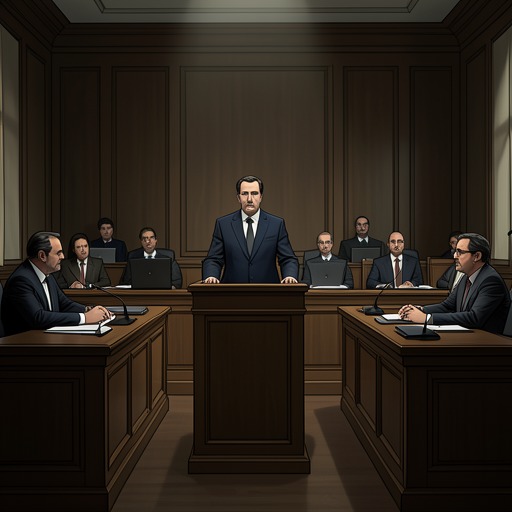
Watergate Grand Jury
All the President's MenThe Watergate Grand Jury was a central but only partly visible institution in the reporting on the Watergate investigation. Its questioning produced testimony that could connect campaign personnel to the political espionage operation, while witnesses’ accounts of what they had told the jury became a consequential—and, in Hugh Sloan’s case, disputed—part of the public story. The account does not describe the jury’s membership or its full proceedings; instead, it shows how fragments of testimony reached reporters and how carefully those fragments had to be distinguished from what witnesses had actually said under questioning.
A forum obscured by silence
The jury’s work was difficult for reporters to reconstruct from outside. During nighttime visits to Committee for the Re-election of the President employees, Bernstein and Woodward encountered fear rather than ready disclosure. One employee trembled and pleaded with Bernstein to leave before others saw him; another said she wanted to help, then burst into tears. These encounters conveyed the pressure surrounding the committee, but they did not establish what any particular witness had told the jury.
Sally Harmony’s testimony became one focus of the reporters’ inquiries. A Justice Department attorney told Bernstein that Watergate prosecutors were suspicious of Harmony’s testimony but lacked evidence to charge her with perjury. At committee headquarters, her lack of candor seemed widely suspected, yet employees could offer no specific account of what she had lied about beyond the suggestion that she was protecting others. The distinction mattered: suspicion about testimony was not proof of what had been said to the jury or of what the witness had concealed.
The Bookkeeper, who had worked for Hugh Sloan before being promoted to work for Maurice Stans, described being called before the jury early in the investigation. She recalled that “nobody knew what questions to ask” and that people had already lied to the jurors. She also said that Harmony and others had lied, while making clear that she and Harmony had not discussed the matter. Her account supplied a witness’s view of the early questioning and the atmosphere around it, not a complete record of the jury’s inquiry.
What witnesses said they told the jury
Donald Segretti’s account, relayed to the reporters by Larry Young, described questioning that began with innocuous matters and his calls from E. Howard Hunt. According to Young’s report of Segretti’s account, the questions initially avoided the lawyer who had paid him and the people for whom he was working. Then a woman member of the jury asked who had paid him and whom he knew on the White House staff. Segretti said that names emerged, especially Dwight Chapin’s, and that he gave the jury the name of the West Coast lawyer who had paid him. Young also said Segretti had described a scurrilous mailing attacking Hubert Humphrey and designed to look as if it came from George McGovern’s supporters. Segretti reportedly characterized himself as one of many small operatives. The information suggested to Bernstein that prosecutors had been told of links to White House staff, although the account makes clear that reporters were receiving this narrative through Young, not from a transcript of the proceeding.
Sloan’s testimony became more contentious. The Washington Post prepared a story that could be attributed to secret grand-jury testimony by Sloan, a former CRP treasurer and former White House aide to H. R. Haldeman. After the report appeared, Daniel Schorr confronted Sloan and his attorney outside a law office where Sloan was to give a deposition. The attorney gave an unequivocal denial that Sloan had implicated Haldeman in his testimony.
Sloan later clarified the boundary of that denial. He said Haldeman’s name had never come up in his grand-jury interviews: “I never said it before the grand jury. I was never asked.” He stressed that the denial was limited to the Post’s story and did not aim to influence the reporters’ further investigation. The distinction left two questions separate: what Sloan believed about Haldeman’s control of the fund, and what the jury had actually asked him. Sloan’s account, as reported in the book, was that the matter had not come up in his testimony.
Testimony, reporting, and correction
The episode demonstrates how information associated with the Watergate Grand Jury moved through several hands before becoming a published claim. A witness described his testimony to reporters; reporters interpreted what they had heard; and a story attributed a specific allegation to the testimony. Sloan’s later denial showed that the attribution could be wrong even while the underlying question of Haldeman’s control of the fund remained open to reporting. The book recounts the reporters’ confidence, the public contradiction, and their effort to determine whether they had misunderstood Sloan or whether he had understood their question differently.
The jury’s significance in this account therefore lies not only in the evidence witnesses supplied, but also in the limits imposed by access to that evidence. The jury could ask questions and receive answers, yet reporters outside the proceedings depended on accounts from witnesses and intermediaries to learn what had happened inside. Segretti’s reported description of a juror’s question suggested that the inquiry reached toward payment and White House connections; Sloan’s correction showed why a reported connection could not safely be treated as grand-jury testimony without verification.
The organization within a climate of pressure
The surrounding accounts place the jury’s work against a campaign organization where employees feared speaking and where the instruction to preserve unity could discourage disclosure. Sloan said that lawyers had not expressly ordered him to remain silent, but that the message was clear: “Hold ranks,” or “Keep the ship together.” He also said his lawyers advised against public statements because they might be used against him in a civil suit connected to his role as campaign treasurer. His reluctance to speak publicly thus coexisted with his having testified before the jury, and the account does not treat those as the same kind of disclosure.
The jury’s proceedings also sat within a broader evidentiary trail. Sloan told the reporters that campaign payments had been authorized by telephone, initially by John Mitchell and later by others, including Jeb Magruder. His description helped the reporters connect the fund’s authorization structure to the cash disbursements they were investigating. But that reporting about the fund must not be confused with the separate question of what Sloan testified to the jury about Haldeman: Sloan explicitly said Haldeman’s name had not come up in his grand-jury interviews.
The Watergate Grand Jury consequently occupies a double role in the narrative: it is an investigative forum whose questioning could elicit consequential names and relationships, and an institution whose secrecy made its work hard to verify from outside. The resulting uncertainty did not make all witness accounts equivalent or render them useless. It made precision essential—especially when the difference between what a witness said to reporters and what the witness said before the jury became a public test of the reporting itself.